

Alert Triage
When an alert fires, the first question is always: is this real, and what’s causing it? NOFire pulls context from your metrics, logs, and recent changes, then tells you what’s happening.Automatic (Slack)
When NOFire AI is in your alert channel, it picks up incoming alerts and posts an explanation in-thread. No commands needed. NOFire runs a full investigation automatically: it checks the evidence, tests hypotheses, and posts findings with a confidence score. For the full investigation output, see Root Cause Analysis.On-demand
Ask about a specific alert in Slack, the Chat dashboard, or your IDE:What gets checked
For each alert, NOFire looks at:- Metrics: what the signal looks like before and after the threshold was crossed
- Recent changes: deployments, config updates, or pod restarts near the alert time
- Related signals: other services or metrics that changed at the same time
- History: has this alert fired before? Is it a known pattern?
- Downstream impact: which other services are affected
Alert types
Pod / Container alerts
Pod / Container alerts
CrashLoopBackOff, OOMKilled, PodNotReady, high restart counts. NOFire checks logs, resource usage, and recent config changes.
Latency and SLO alerts
Latency and SLO alerts
P99 latency breaches, SLO burn rate alerts. NOFire finds the slow path and the bottleneck service.
Error rate alerts
Error rate alerts
5xx spikes, high error rates. NOFire pulls error logs, checks recent deploys, and identifies the source.
Resource pressure alerts
Resource pressure alerts
CPU throttling, memory pressure, disk pressure. NOFire identifies which pods are responsible and whether a recent change caused the increase.
Infrastructure alerts
Infrastructure alerts
Node NotReady, etcd issues, network errors. NOFire checks cluster-level events and other affected workloads.
Alert Audit & Fix
Between incidents, NOFire can review your alert rules and tell you what needs fixing: noisy alerts, missing coverage, stale thresholds, SLO misalignment.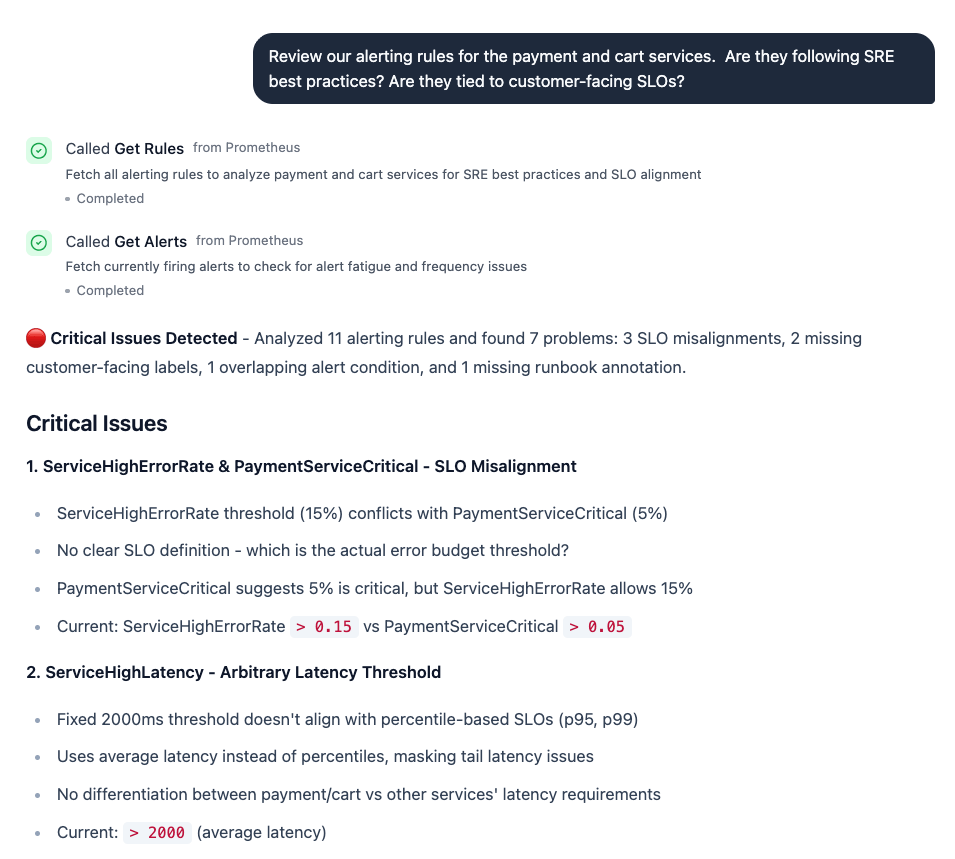
Alert audit result: 11 rules analyzed, 7 issues found including SLO misalignments, missing labels, and arbitrary thresholds.
How to use it
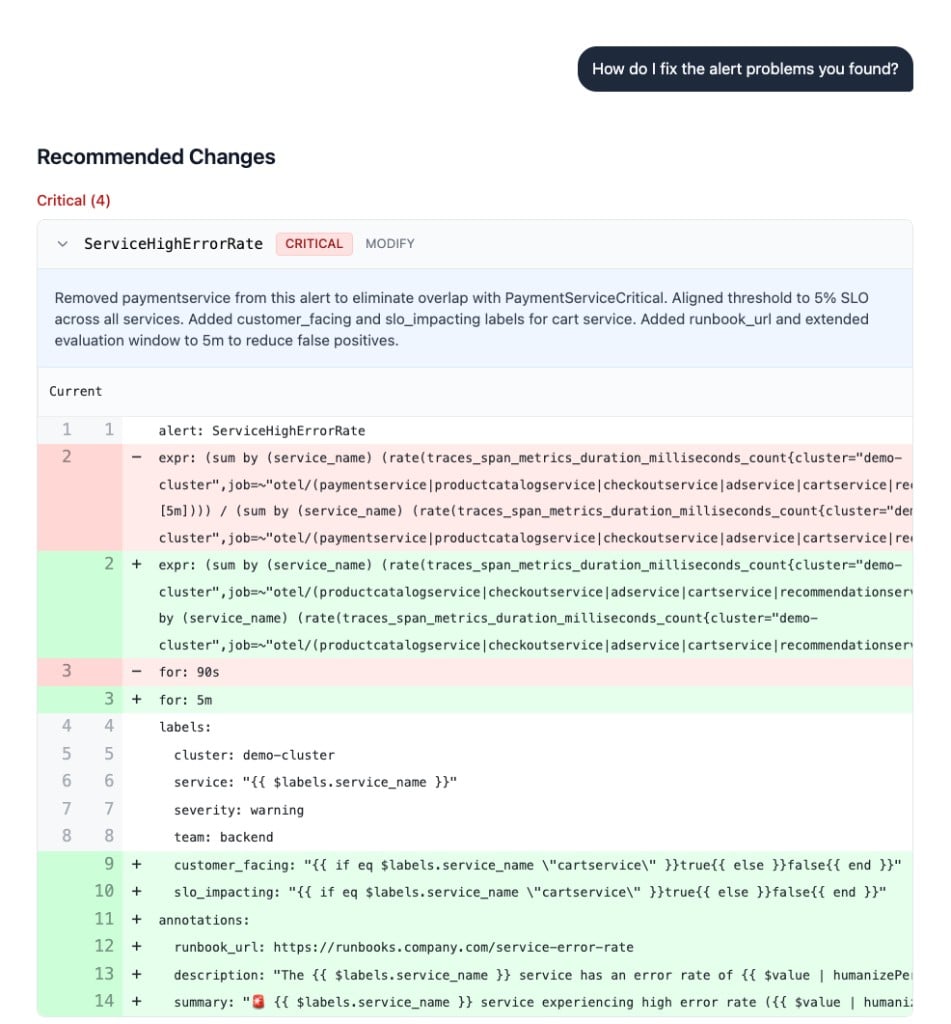
Alert fix — NOFire generates the exact rule changes with a diff view. SLO threshold aligned, evaluation window extended, customer-facing labels and runbook added.
What gets reviewed
- Noisy alerts: rules that fire frequently without leading to action
- Missing coverage: services or failure modes with no alerts at all
- Stale thresholds: thresholds that haven’t been updated as traffic or infrastructure changed
- Duplicate alerts: overlapping rules from different tools that fire for the same condition
- Suggested fixes: concrete changes to thresholds, conditions, or grouping
Common scenarios
Reduce alert fatigue
Reduce alert fatigue
Set up alerts for a new service
Set up alerts for a new service
Post-incident: why didn't we catch this earlier?
Post-incident: why didn't we catch this earlier?
Available in
- Slack: triage happens automatically in alert channels; audit and follow-ups via
@NOFire AI - Chat dashboard: my.nofire.ai
- IDE (MCP): query alert status while coding
Getting Started
1
Add NOFire AI to your alert channel
Invite
@NOFire AI to the Slack channel where your alerts land. See Slack setup →2
Connect your triggers
Configure Grafana IRM or Slack trigger routing so alerts reach NOFire. See trigger setup →
3
Ask for an audit
Once you have alert history flowing, ask NOFire to review your rules and suggest improvements.
Root Cause Analysis
Go deeper into why an incident happened
Slack Installation
Set up the NOFire AI Slack app