

Overview
Before you deploy, NOFire AI tells you which services are affected, what the risk level is, and how to deploy safely — based on your actual infrastructure and live service dependencies. Powered by: NOFire AI Edge builds a causal graph of your infrastructure. NOFire AI uses this graph to assess deployment impact and risk based on live service dependencies and historical patterns.What You Get
Know What's Affected
See which production services your code changes touch. See the blast radius before you merge.
Risk Score
Clear risk assessment: Low, Medium, or High. Know if you can deploy now or need extra precautions.
Right Deployment Strategy
Specific guidance: standard deploy, canary rollout, or staged deployment with team present.
See Potential Cascade
One service change or cascade to critical business functions? See the downstream impact before it reaches production.
Historical Context
Warnings if a service had recent incidents or rollbacks. Don’t repeat last week’s mistakes.
IDE Integration
Check risk while coding in Cursor or Claude Desktop. No context switching required.
Real-World Impact
- Payment Service
- Large Refactoring
- Daily Development
Without NOFire AI
- Friday afternoon deploy
- Payments fail 10 min later
- 15 services cascading failure
- 2 hours incident response
- Revenue impact + angry customers
With NOFire AI
- HIGH RISK warning before merge
- Recent instability alert shown
- Deploy rescheduled to Tuesday
- Canary rollout catches issue
- Zero production impact
How to Use It
In Your IDE
Check risk while coding in Cursor or Claude Desktop. Ask: “What’s the deployment risk?”
In Slack
Ask
@NOFire AI about deployment risk and get team-wide visibility during reviews.In Chat Dashboard
Review risks and dependencies at my.nofire.ai before deploying.
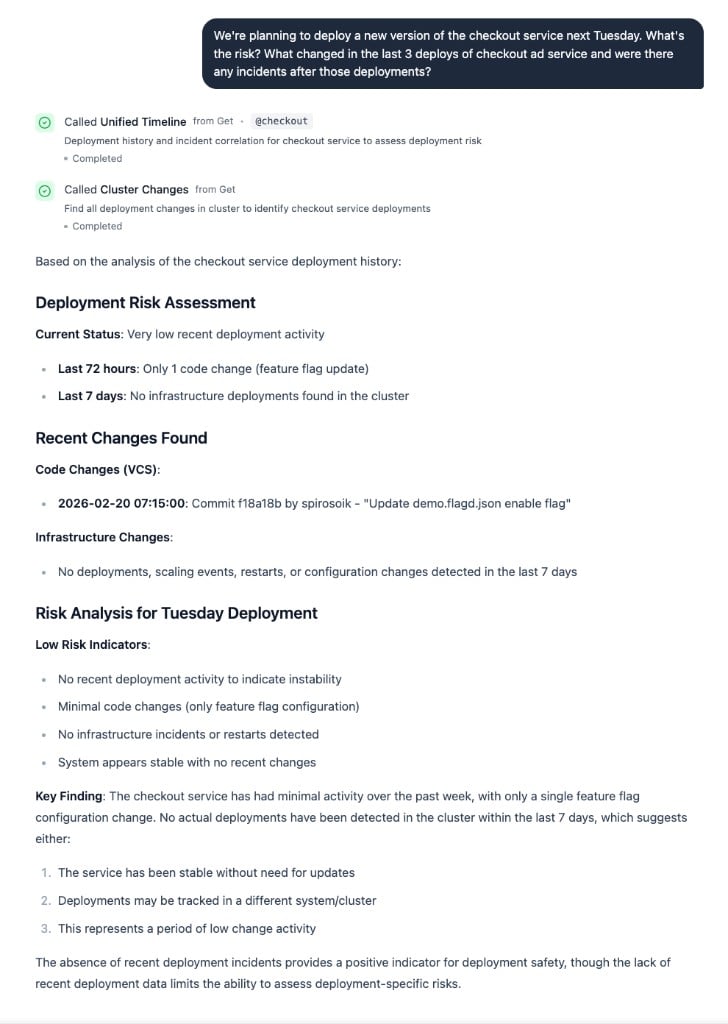
Deployment risk assessment in the Chat dashboard — checking risk before a Tuesday deploy of the checkout service.
Best Practices
- Automate Risk Checks
- Make It Routine
- Team Practices
Add NOFire AI to your See complete MCP integration guide →
AGENTS.md so AI coding agents automatically check risk:Production Readiness Reviews
Before a major launch or migration, ask NOFire to create a production readiness review. It pulls deployment risk, service dependencies, recent incidents, and current health into a structured ticket — so your team has a single artifact to review.Getting Started
1
Install NOFire AI Edge
Deploy the Kubernetes agent that builds your causal graph. This is required for deployment risk assessment.Install NOFire AI Edge →
2
Connect Your IDE
Set up MCP integration to query NOFire AI from Cursor, Claude Desktop, or other MCP-compatible tools.Set up MCP integration →
3
Try Your First Risk Check
Make a code change, then ask: “What’s the deployment risk for these changes?”Review the risk score, affected services, and deployment strategy recommendation.
MCP Integration
Set up IDE integration to check deployment risk while you code
API Tokens
Generate and manage MCP API tokens
NOFire AI Edge
Learn how NOFire maps your service dependencies
Security
Understand our security model
Good to Know
Initial Learning Period
Initial Learning Period
NOFire AI learns your environment immediately after NOFire AI Edge connects. Risk assessments get more accurate as it observes deployment patterns and service interactions.
New Services
New Services
Brand new services get conservative risk assessments based on their architecture and dependencies. Accuracy improves after observing a few deployments.
What It Doesn't Cover
What It Doesn't Cover
NOFire AI analyzes your monitored infrastructure and causal graph. It doesn’t cover external service failures, third-party API issues, or manual operational mistakes outside your cluster.
Gets Better Over Time
Gets Better Over Time
The causal graph and risk models learn continuously. More usage means more accurate risk assessments for your specific environment.